
Executive Summary
In an interconnected financial world defined by rapid technological change, evolving central bank policies, and persistent macroeconomic uncertainties, protecting multi-generational capital demands a comprehensive strategy. Family offices, business owners, and corporate treasuries face overlapping challenges. On one hand, idle cash reserves suffer constant erosion from rising consumer prices; on the other hand, expanded exposures to digital asset ecosystems bring unique custody, technical security, and operational risks.
Navigating today’s financial environment requires bridging time-tested fiduciary capital planning with modern liquidity strategies and specialized blockchain security protocols. Building a truly resilient balance sheet involves integrating bespoke private advisory services, dynamic short-term cash yields, and advanced on-chain forensic tracking tools. By aligning wealth management, yield optimization, and cryptographic investigation, allocators can safeguard their wealth against structural inflation, market volatility, and digital asset threats.
Fiduciary Wealth Governance and Long-Term Capital Preservation
Preserving substantial private enterprise equity and liquid assets across changing market cycles requires moving far beyond basic commercial banking and standardized investment products. High-net-worth individuals and corporate founders operate in complex regulatory frameworks marked by evolving tax structures, cross-border estate governance, and dynamic liability risks. Protecting long-term capital demands a high-touch advisory model engineered to shield core assets from extreme downside drawdowns while capturing sustainable growth.
Professional advisors construct multi-asset portfolio strategies tailored to each family office or enterprise mandate. These allocations balance public equities with private debt, commercial real estate holdings, sovereign debt instruments, and non-correlated alternative assets. Furthermore, dedicated fiduciary advisors collaborate closely with estate planning attorneys and tax specialists to establish family trusts, holding entities, and succession plans that preserve wealth across generations.
Partnering with experienced private wealth management services provides private investors with specialized portfolio construction, strict fiduciary oversight, and multi-generational capital protection designed to navigate shifting economic cycles successfully.
Working Capital Optimization and Short-Term Yield Management
While long-term growth investments drive broad portfolio expansion, maintaining optimized short-term liquid reserves is essential for ongoing operational stability. Allowing working capital or transaction reserves to remain in standard demand deposit accounts creates continuous balance sheet erosion, as baseline inflationary dynamics reduce cash purchasing power over time. Treasuries and family offices must execute active cash-laddering strategies to maximize returns on liquid assets without taking on excess duration or credit risk.
Optimizing liquidity involves evaluating institutional money market vehicles, short-term sovereign treasury bills, and high-yielding liquid bank accounts. Staggering maturity dates across liquid tranches establishes a predictable stream of maturing cash that can be continuously rolled over into prevailing market rates during rate adjustments. Maintaining structured cash reserves also grants the strategic agility required to capture sudden market opportunities without disturbing core long-term investment portfolios.
Holding short-term cash reserves in a dedicated high interest rate savings account enables corporate treasuries and private allocators to earn competitive yields on liquid balances while maintaining immediate access for tactical capital deployment.
Macroeconomic Inflation Cycles and Real Capital Preservation
Designing an effective long-term asset protection framework begins with a thorough quantitative evaluation of broad macroeconomic trends and core price indicators. Inflation acts as an ongoing drag on uninvested cash holdings, steadily reducing the volume of physical commodities, real estate, and corporate equity that a given currency amount can purchase. When broad cost-of-living increases outpace nominal banking yields, net investment returns become negative, leading to balance sheet contraction in real purchasing power terms.
Central banks modify benchmark interest rates to manage economic growth velocity and control baseline price stability targets. As benchmark rates shift, commercial lending rates, sovereign bond yields, and consumer deposit rates recalculate across the wider financial ecosystem. Capital managers must continuously evaluate real yields—the net spread between nominal returns and underlying price adjustments—to refine asset allocation models and protect cash reserves against long-term purchasing power decay.
Monitoring ongoing fluctuations in the core consumer price index enables family offices and corporate treasuries to adjust portfolio durations dynamically, insulating balance sheets against long-term inflationary pressures.
Digital Asset Security, On-Chain Tracking, and Forensic Capital Recovery
As digital currencies, cryptographic assets, and tokenized financial instruments become standard elements within multi-asset balance sheets, allocators must address the unique security parameters governing public blockchain networks. Although cryptographic ledgers deliver complete transactional history and immutability, operating in decentralized environments introduces exposure to cyber threats, unauthorized wallet transfers, and complex online fraud schemes. Because blockchain transactions are permanent and lack central administrative channels, addressing security breaches demands specialized forensic procedures.
When digital funds are compromised or misdirected to unauthorized wallet addresses, technical blockchain tracing procedures must be launched immediately. Forensic investigators analyze transaction graphs, cluster associated wallet infrastructure, track cross-chain bridge movements, and identify deposit endpoints at centralized digital asset exchanges. Documenting verified technical evidence and presenting audit-ready reports to global law enforcement creates the necessary legal foundation to freeze illicit funds at exchange entry points and execute asset recovery.
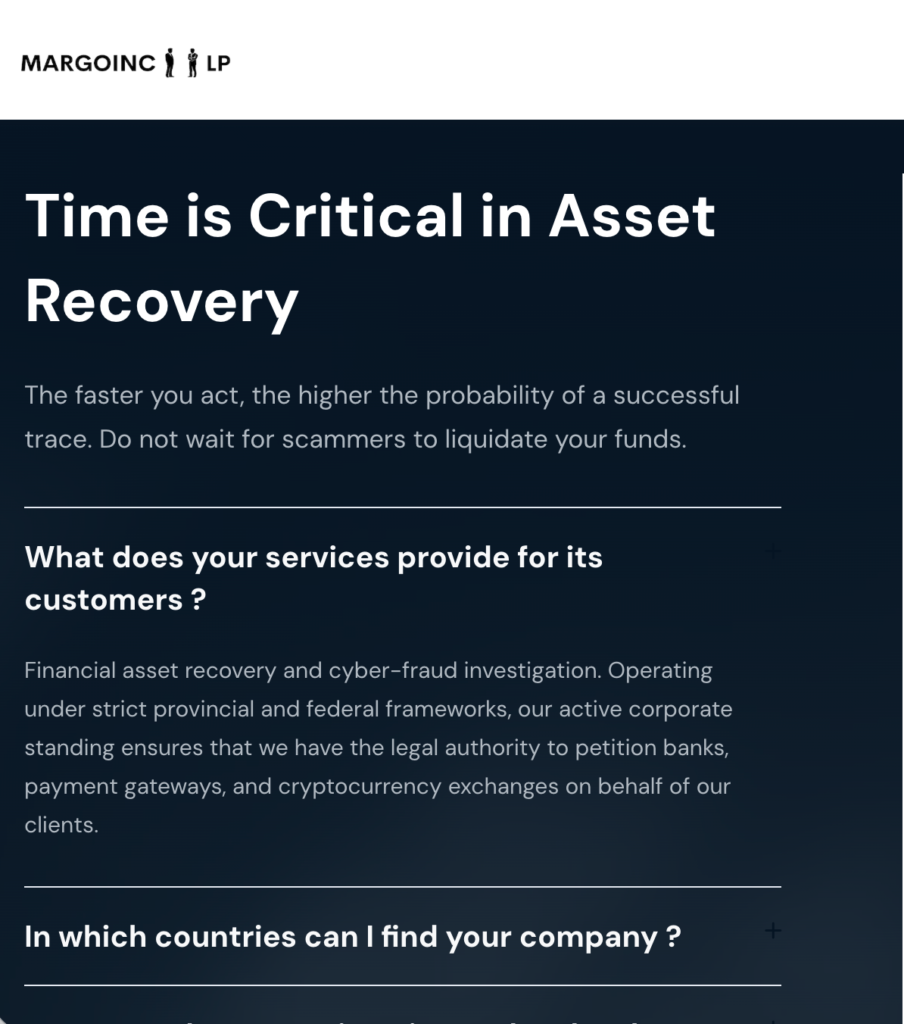
Collaborating with a dedicated digital asset recovery specialist through MARGOINCLP.COM assists individuals and commercial organizations in tracing unauthorized wallet movements, compiling verified technical evidence, and coordinating with global law enforcement agencies to freeze and recover compromised digital capital.
Conclusion
Sustaining long-term capital efficiency, structural asset protection, and multi-generational financial success requires an integrated operational approach. By combining fiduciary private capital advisory, maximizing yields on short-term liquid cash against core price benchmarks, and maintaining specialized on-chain forensic tracing capabilities, allocators and business executives can build an enduring financial foundation built to perform across all market environments.